
Why The "Gold Standard" Isn't Working For You

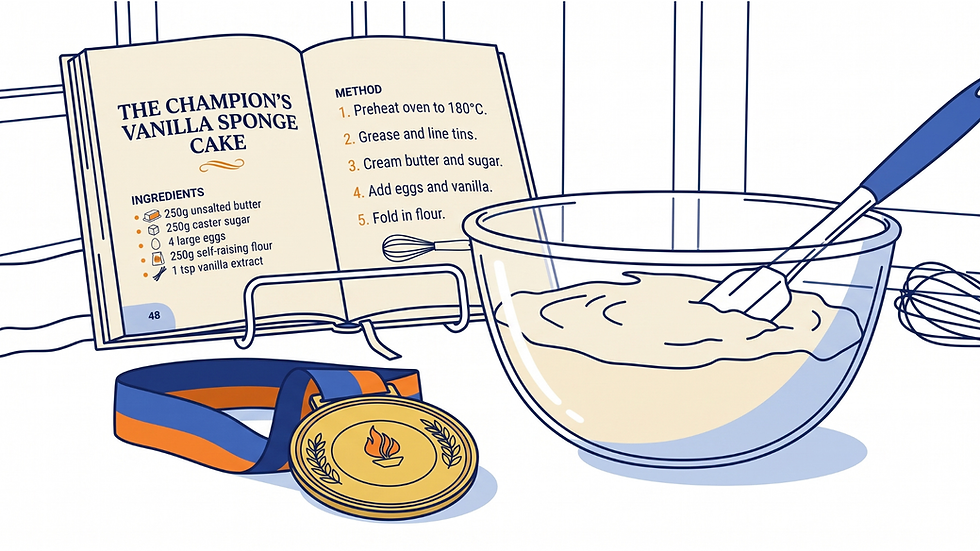
You are baking a cake from a recipe in a cookbook - this is the gold standard. The recipe calls for your oven to work on fan-bake, but you only have the option of bake. Whilst a subtle difference, a change in approach must be made. You can't simply assume that the same temperature and time will yield the same results. Yet, with your own judgment you know that adjustments to temperature and time (as well as checking near the end) will allow you to achieve the desired result. Despite the recipe providing the specific framework, the context of your situation required change.
And now imagine if you had continued exactly as the recipe stated but didn't allow for the difference. You take the cake out of the oven and lament at how underdone it is in the centre. You are rigid to the recipe but don't experience the results promised.
What we have here is the difference between Evidence-Based Practice and Evidence-Informed Practice. And before you run away because of a slight semantic change, you might find this is one of the biggest causes of friction in your own learning.
Why EBP and EIP are relevant to you
Evidence-Based Practice (EBP) is the process of applying proven science and research into a similar context. In an educational setting, it refers to being able to make appropriate decisions in teaching and learning practice that come from sound research and methodology. Evidence-Informed Practice (EIP) takes this a step further to allow the practitioner to use judgment based on additional factors and their own experience to support the decision that is made. It doesn't discount the research, instead it uses this in combination with other evidence that wasn't present in the initial research to make a relevant decision. The research remains the gold standard, however the application is in the hands of the person who is able to judge the context correctly.

The challenge occurs when you are either in the position of an independent learner or the leader of the learning. As an independent learner, the direct application of a particular learning method might seem straight forward but can quickly become frustrating if the results don't match the promised outcomes. The same for a teacher or facilitator of learning, treating each cohort in the same manner and with a specific rigidity to the application of the evidence-based learning without a consideration for how the context varies between session or context. Both of these can be the "gold standard" of learning, but there is unlikely to be any "gold standard" learning taking place.
It's not that the research and evidence is wrong, but a rigid adherence will be leading you astray.
Implementation challenges in the real-world
You can have all of the right knowledge, but the application of this to a particular context can prove to be the decider.
I'm always fascinated by the way that so many successful people can provide templates that led to their own success that don't seem to work for others. "If I can do it, then you can too" becomes a mantra for the self-improvement cycle but fundamentally promises a future that can never be realised. This filters down to learning in many ways. Each time a "gold standard" is held up, it provides an accurate account of a specific system but often neglects factors that are not transferrable, with timing of when the knowledge developed being out of context in the current environment. It's not that it can't work for you, it's the difference between recognising that they baked their cake in an oven, and all you have is a microwave.
In reality, integrating EBP relies on a series of assumptions, particularly causal assumptions (if I do this, I will get this result) of something has worked in this context, therefore it will also apply in mine. EIP challenges the assumption through determining what variation exists between the initial research the current context of the learner. It acknowledges that there is often not an absolute and that the approach to learning may need to change. This is often undertaken by a professional who is able to apply judgment to the situation, recognising the nuances of context.
Realistic Conclusion
Your gold standard will vary by your context. Recognising the nuances of what the science reveals alongside your own personal experiences is often the the best indicator for the next step. If something doesn't seem right, you adjust, if you observe that the strict adherence isn't progressing as determined, you pivot. Evidence-Based Practice will provide the framework, Evidence-Informed Practice will provide the right application in your context.
References:
Kumah EA, McSherry R, Bettany-Saltikov J, van Schaik P, Hamilton S, Hogg J, Whittaker V. Evidence-informed practice versus evidence-based practice educational interventions for improving knowledge, attitudes, understanding, and behavior toward the application of evidence into practice: A comprehensive systematic review of UG student. Campbell Syst Rev. 2022 Apr 16;18(2):e1233. doi: 10.1002/cl2.1233. PMID: 36911346; PMCID: PMC9013402.
Nelson, J., & Campbell, C. (2017). Evidence-informed practice in education: meanings and applications. Educational Research, 59(2), 127–135. https://doi.org/10.1080/00131881.2017.1314115


Comments